How to Read a Porsche VIN: What Every Digit Means
Understanding your Porsche’s VIN (Vehicle Identification Number) is like reading its DNA. Every digit tells a story – where it was built, what engine it has, what model year it is, and its unique place in the production run. Whether you’re buying a used Porsche, verifying a car’s history, or just curious about what those 17 characters mean, this guide breaks it all down.
What Is a Porsche VIN?
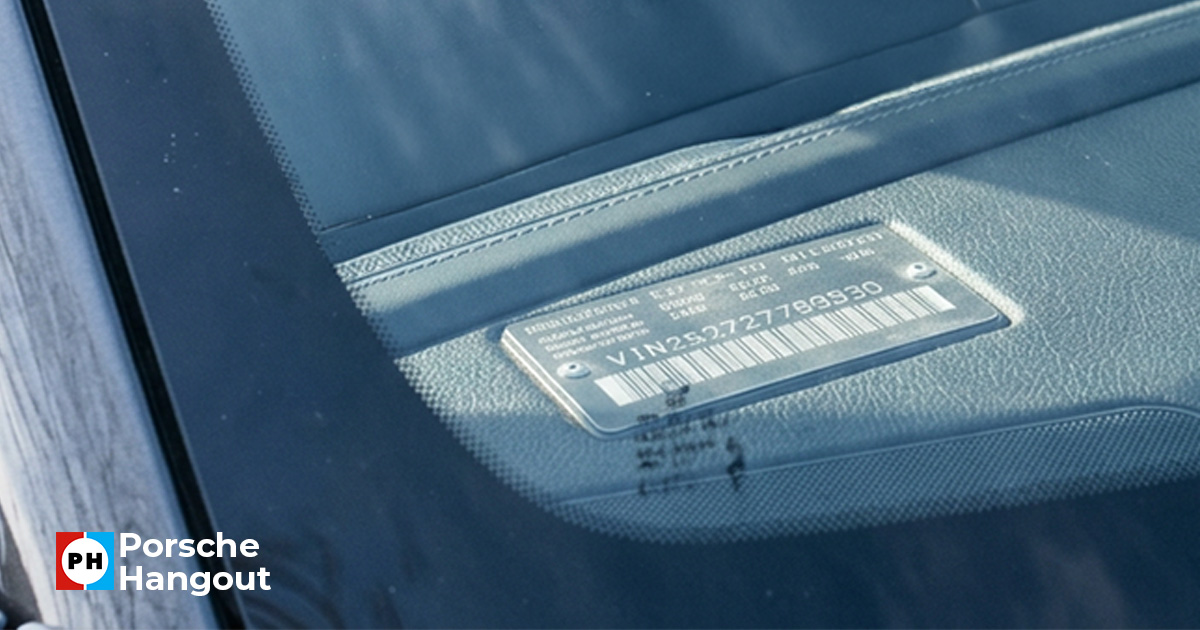
Every Porsche built since 1981 has a standardized 17-character VIN that serves as its unique fingerprint. No two vehicles in the world share the same VIN. It’s stamped into the chassis, printed on a plate visible through the windshield on the driver’s side, and recorded in every service record, insurance document, and title transfer for the life of the car.
Before 1981, Porsche used shorter serial numbers that varied in format. The 17-digit international standard was adopted worldwide to create a uniform identification system across all manufacturers.
You’ll find your Porsche’s VIN in several places:
- On a metal plate visible through the lower driver’s side windshield
- On the driver’s door jamb sticker
- On the vehicle title and registration
- In the engine bay (on older models)
- In your Porsche Connect app or owner’s portal
Breaking Down the 17 Digits
Every Porsche VIN follows the same structure. Here’s what each position means:
Positions 1-3: World Manufacturer Identifier (WMI)
The first three characters identify who built the car and where:
| Code | Meaning |
|---|---|
| WP0 | Porsche, manufactured in Germany (Stuttgart/Zuffenhausen or Leipzig) |
| WP1 | Porsche SUV (Cayenne/Macan), manufactured in Leipzig, Germany |
Important note: The third character is a zero (0), not the letter O. This is one of the most common mistakes people make when entering a Porsche VIN into decoder tools. If your VIN lookup returns no results, check that you typed WP0 with a zero.
Position 4: Model and Body Type
The fourth character identifies the model family and body configuration:
| Code | Model |
|---|---|
| A | 911 (991/992 generation) |
| B | 911 Cabriolet / Targa |
| C | 718 Cayman / Boxster |
| E | Cayenne |
| J | Macan |
| G | Panamera |
| Y | Taycan |
Notice that position 4 is where a coupe (code A) and a Cabriolet or Targa (code B) diverge — the body style is baked into the VIN itself. If you’re weighing the two, our Coupe vs Cabriolet comparison lays out the real weight, 0-60, top speed and rigidity trade-offs side by side.
Position 5: Engine Type
This digit tells you what powers the car. For the 911:
| Code | Engine |
|---|---|
| B | 3.0L Twin-Turbo Flat 6 (Carrera) |
| F | 3.7L Twin-Turbo Flat 6 (Turbo/Turbo S) |
| G | 4.0L Naturally Aspirated Flat 6 (GT3/GT3 RS) |
This is particularly useful when verifying that a car actually has the engine it’s claimed to have – a common concern when buying used.
Position 6: Safety and Restraint Systems
Indicates the type of seatbelts and airbag configuration. This varies by market (US, European, Middle East, etc.) and model year.
Positions 7-8: Model Variant
These two characters narrow down the specific variant within the model family – for example, distinguishing a Carrera S from a Carrera GTS, or a rear-wheel-drive model from an all-wheel-drive version.
Position 9: Check Digit
This is a mathematically calculated verification digit. It’s computed using a formula applied to all other 16 characters in the VIN. This exists to catch transcription errors – if someone mistypes a single digit, the check digit won’t validate and the VIN will be flagged as invalid. This is why legitimate VIN decoders can tell you instantly if a VIN has been entered incorrectly.
Position 10: Model Year
The tenth digit encodes the model year using a rotating system of letters and numbers:
| Code | Year | Code | Year |
|---|---|---|---|
| A | 2010 | J | 2018 |
| B | 2011 | K | 2019 |
| C | 2012 | L | 2020 |
| D | 2013 | M | 2021 |
| E | 2014 | N | 2022 |
| F | 2015 | P | 2023 |
| G | 2016 | R | 2024 |
| H | 2017 | S | 2025 |
Note that the letters I, O, Q, U, and Z are never used in VINs to avoid confusion with numbers.
Position 11: Assembly Plant
Identifies which Porsche factory assembled the vehicle:
- S – Stuttgart-Zuffenhausen (911, 718)
- L – Leipzig (Cayenne, Macan, Panamera, Taycan)
- N – Valmet Automotive, Finland (contract assembly for some Boxsters)
Positions 12-17: Sequential Production Number
The final six digits are the unique serial number assigned to your specific car as it rolled off the assembly line. Combined with all the preceding information, these digits make your VIN completely unique in the world.
How to Use Your Porsche VIN
Knowing how to read a VIN is useful in several real-world situations:
Buying a used Porsche: Verify the VIN on the car matches the title. Check that the engine code (position 5) matches what the seller claims. A GT3 should have a “G” in position 5 for the 4.0L NA engine – if it shows a “B” for the twin-turbo, something is wrong. Still shopping? Our Find My Porsche tool searches live US dealer inventory so you can line up real cars for sale and check each one’s VIN before you ever pick up the phone.
Ordering parts: Many Porsche parts are model-year and variant specific. Your VIN ensures you get exactly the right part for your car.
Checking recall status: Porsche issues recalls by VIN range. Entering your VIN on the NHTSA recall lookup shows any open recalls for your specific car.
Insurance and registration: Your VIN is how insurance companies and DMVs identify your vehicle. Errors in the VIN on your documents can cause problems at registration time.
Verifying production numbers: For limited-edition models, the sequential number (positions 12-17) combined with the model code can tell you approximately how many were made and where yours falls in the production run.
Decode Your Porsche VIN Instantly
Want to see everything your VIN reveals about your Porsche? Use our free Porsche VIN Decoder – enter your 17-digit VIN and get a complete breakdown of your car’s specifications, model details, and production information. No registration required, completely free.
Now Decode Your Build Sticker
Your VIN tells you what your Porsche is. The M-codes on your build sticker tell you exactly what it came with — Sport Chrono, the factory LSD, PCCB ceramic brakes, the X51 Power Kit. Decode the full list for free with our Porsche Option Code Decoder.