Are Porsches Automatic or Manual? Porsche Transmissions Explained
The Short Answer
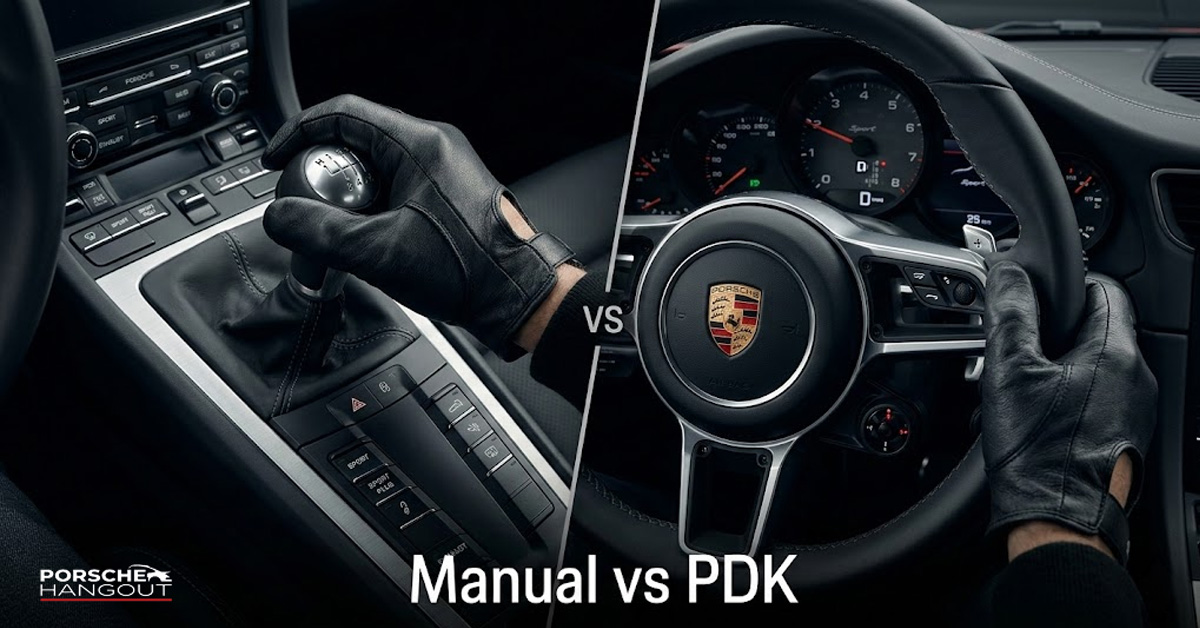
Modern Porsches are available with both automatic and manual transmissions — but the automatic in question is not your typical slush box. Porsche uses a dual-clutch transmission called PDK (Porsche Doppelkupplungsgetriebe), which shifts faster than any human can move a gear lever. Today, nearly 90% of 911 buyers choose PDK over the manual.
But the story of how Porsche got here spans six decades, three different automatic technologies, and one of the most passionate debates in the car world.
A Brief History of Porsche Transmissions
The Manual Era (1948–1990)
For the first four decades of production, every Porsche came with a manual gearbox. The original 356 used a 4-speed synchronized transmission, and when the 911 arrived in 1964, it brought a 5-speed manual that would remain the backbone of the lineup for over 20 years.
The early 911 gearboxes were not without their quirks. The original 901 transmission was known for balky shifts when cold, and the shift pattern took some getting used to. But once warmed up and in the hands of a competent driver, the mechanical connection between human and machine was unmatched.
The 915 gearbox used from 1972 to 1986 was stronger but heavier, and the shift quality was polarizing — some loved its rugged precision, others found it notchy. Porsche finally introduced the G50 gearbox in 1987, featuring a Borg-Warner synchronizer system that transformed the 911 shifting experience. The G50 is widely regarded as one of the finest manual transmissions ever made.
Sportomatic: The First Experiment (1968–1980)
Porsches first attempt at removing the clutch pedal was the Sportomatic, introduced in 1968. It was essentially a manual gearbox with an automatic clutch — you still moved the shift lever between gears, but touching the lever activated a vacuum-operated clutch so your left foot had nothing to do.
It was innovative but flawed. Over-revving was easy if you accidentally bumped the shift lever, and the system was expensive to maintain. Sportomatic equipped 911s were slower than their manual counterparts and the system never caught on with enthusiasts. Fewer than 10% of buyers opted for it, and Porsche discontinued it in 1980.
Tiptronic: Getting Serious (1990–2008)
When Porsche introduced the Tiptronic on the 964-generation 911 in 1990, it was a genuine step forward. Developed with ZF, the Tiptronic was a conventional torque-converter automatic with a twist: a separate gate in the shift lever allowed drivers to manually select gears by tapping the lever forward or back.
This was revolutionary at the time. No other sports car offered a true automatic that also gave you manual control. The name “Tiptronic” came from the tipping motion of the lever. Later versions added steering wheel buttons for shifts.
But Tiptronic had real compromises. The 964 Tiptronic was 1.3 seconds slower to 60 mph than the manual, cost $2,950 extra, and the torque converter meant some power was always lost in translation. Shift speeds, while impressive for an automatic, could not match a skilled driver rowing through a manual gearbox.
Porsche refined the Tiptronic through the 993 and 996 generations, adding a 5-speed version and improving shift logic. But enthusiasts were never fully satisfied. The Tiptronic was viewed as a compromise — acceptable for daily driving, but missing the soul of the manual.
PDK: The Game Changer (2009–Present)
Everything changed with PDK. Introduced on the 997.2 generation 911 in 2009, the Porsche Doppelkupplungsgetriebe (Porsche Dual-Clutch Transmission) was not actually new — Porsche had been developing the concept since the 1960s and first raced a prototype dual-clutch in the 962 at Le Mans in 1986.
But it took decades for the computer technology and engineering to catch up with the idea. When it finally arrived in production form, PDK immediately made the Tiptronic obsolete.
How PDK Actually Works
The genius of PDK lies in its twin-clutch design. Instead of one clutch and one input shaft like a manual, PDK uses two wet clutches arranged concentrically (one inside the other) connected to two coaxial input shafts.
One clutch handles the odd gears (1, 3, 5, 7), the other handles the even gears (2, 4, 6, and reverse). Here is the key insight: while one gear is engaged and driving the wheels, the next gear is already pre-selected on the other shaft, just waiting for its clutch to engage.
When you need to shift, one clutch opens while the other closes simultaneously. There is no gap in power delivery. The result is shift times as low as 100 milliseconds — far faster than any human can physically move a shift lever and operate a clutch pedal.
The current 8-speed PDK in the 992-generation 911 is the most refined version yet. It offers:
- 8 forward gears for optimal performance and fuel efficiency
- Launch control for maximum acceleration from a standstill
- Manual mode via steering wheel paddles or the center console lever
- Sport and Sport Plus modes that alter shift points, rev-matching, and throttle response
- Automatic rev-matching on downshifts, producing the perfect blip every time
The numbers speak for themselves. A 992 911 Carrera S with PDK hits 60 mph in 3.3 seconds — 0.4 seconds quicker than the manual. Around the Nurburgring, the PDK advantage can be 8 seconds or more over a full lap.
Which Porsche Models Still Offer a Manual?
Despite PDKs dominance, Porsche remains one of the few manufacturers still committed to offering manual transmissions. Here is the current breakdown:
Manual available:
- 911 Carrera / Carrera S / Carrera T (7-speed manual)
- 911 GT3 (6-speed manual option alongside PDK)
- 718 Cayman / Boxster (6-speed manual)
- 718 Cayman GT4 / Spyder (6-speed manual option)
PDK only (no manual option):
- 911 Turbo / Turbo S
- 911 GT3 RS
- 911 GT2 RS
- 911 Targa
- Cayenne (8-speed Tiptronic S)
- Macan (7-speed PDK)
- Panamera (8-speed PDK)
- Taycan (2-speed automatic, electric)
Notably, the 911 Turbo has not been available with a manual since the 997 generation ended in 2013. Porsche determined that the Turbos power and AWD system are best managed by PDK.
Manual vs PDK: Which Should You Choose?
This is arguably the most debated question in the Porsche community. Here is an honest assessment:
Choose PDK if you:
- Want the fastest possible acceleration and lap times
- Drive in heavy traffic regularly
- Plan to use launch control
- Want the best fuel economy
- Prefer to focus on steering and braking inputs rather than shifting
Choose manual if you:
- Value driver engagement and mechanical connection above outright speed
- Enjoy heel-and-toe downshifts
- Want total control over gear selection
- Appreciate the ritual and satisfaction of rowing your own gears
- Care about long-term collectibility (manuals typically hold value better)
There is one more factor worth mentioning: resale value. Manual Porsches — particularly GT cars — command significant premiums on the used market. A manual 991 GT3 can be worth $30,000-$50,000 more than an equivalent PDK car. The market has spoken, and it values the manual transmission as a special feature rather than a standard one.
The Future of Porsche Transmissions
The manual transmissions future at Porsche is uncertain but not yet dead. Porsche has acknowledged that PDK outsells manual by a wide margin across every model where both are offered. Yet they continue to engineer manual options because they understand what the stick shift represents: a direct, unfiltered connection between driver and machine.
The Taycan introduced Porsches first two-speed electric transmission — because even in the EV era, Porsche could not resist engineering a gearbox where none was strictly needed. That attention to the driving experience, whether through three pedals or two clutches, is what separates Porsche from every other manufacturer.
Whether you choose manual or PDK, you are getting a transmission engineered to a standard that no other car company can match. And that is the real answer to whether Porsches are automatic or manual — they are whichever one you want, and both are exceptional.
Compare Porsche Models Side-by-Side
Use our free Porsche Model Comparison tool to compare specs, performance, and pricing across different 911 variants and other Porsche models.